Mechano-immunology Lab

The forces of immunity.

Immune cells don't just recognize their targets, they touch, tug, and feel them. These forces help decide whether cells attack or stand down. We are fascinated by these hidden mechanical cues in immunity, and we use what we learn to design next-gen therapies for cancer and beyond.

Research

Immunology has long been understood through the biochemical information exchanged by cells. We know which molecules bind to what other molecules, and recognize which specific targets. But this is not the full story. Immune cells are highly active and dynamic, interacting with their surroundings to collect biophysical information. T cells and NK cells exert and sense piconewton forces through T cell receptors and Fc receptors as they engage other cells, and these forces carry information that shapes how the effector cells respond. Our lab investigates this mechanical dimension of immunity, working across immunology, biophysics, chemical biology, DNA nanotechnology, microscopy, protein and cell engineering.
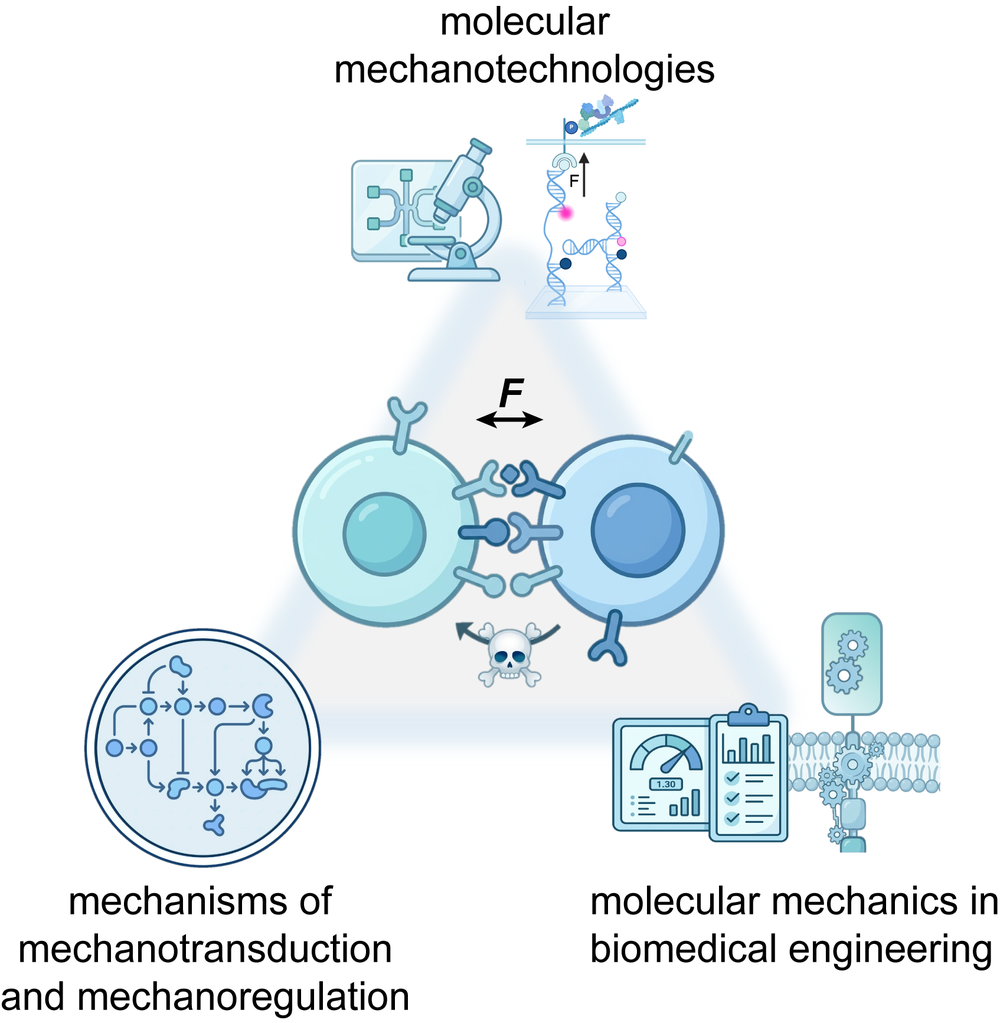
Forces of immunity
Research overview: central cell–cell force interaction (the forces of immunity) surrounded by three themes — molecular mechanotechnologies (top), mechanisms of mechanotransduction and mechanoregulation (left), and molecular mechanics in biomedical engineering (right)

Reading and controlling the forces

We develop new methods to observe and perturb the tiny and dynamic mechanical forces that immune cells generate when they engage and recognize their targets.

Decoding how forces become signals

We investigate how immune cells harness mechanical cues and turn biophysical forces into biochemical signals that shape cell fate.

Engineering forces in immunity

We leverage molecular mechanotechnologies and translate mechanistic insights into diagnostics and design principles for next-generation, force-centric immunotherapies.

Join us

The lab launches in February 2027. We're a new group building something ambitious from the ground up, and the people who join early help shape our lab's culture. You'll work in a highly interdisciplinary environment that welcomes people from diverse backgrounds, and be supported to grow into an independent scientist. If the forces of immunity spark your curiosity and you love tackling open scientific questions, we'd love to hear from you!

Join us on our quest to chase the hidden forces in immunity!

Available

Research Assistant

Hands-on research experience before a PhD or your next step. The duration is flexible, shaped around your goals and career plans.

Apply via Varbi →
Available

PhD Student

A doctoral position for a motivated student excited to work at the interface of immunology and the physical sciences.

Apply by email →
Available

Postdoc

For a recent or soon-to-graduate PhD ready to lead an ambitious, interdisciplinary project. We actively support fellowship applications.

Apply via Varbi →

How to apply

If a position has an application link, please apply through the KI recruitment system (Varbi). If you are interested in joining but do not see a link for the role you want, email Rong at rong.ma@ki.se with a brief statement of your research interests and background, together with your CV. We review every application and respond to all serious enquiries.

Lab news

Feb 2027The Ma Lab opens at Karolinska Institutet (MBB, Biomedicum).
Oct 2026Rong receives a starting grant from the Swedish Society for Medical Research (SSMF).
Oct 2026Rong receives a starting grant from the Swedish Research Council (VR).
2026We are recruiting our founding team. See Join us for open research assistant, PhD, and postdoc positions.

People

Rong Ma

Rong Ma

Principal Investigator

Rong Ma is an incoming Assistant Professor in the Department of Medical Biochemistry and Biophysics at Karolinska Institutet, where her lab opens in 2027 to study mechanical force in immunity. Trained at Emory University during her PhD and at Stanford University during her postdoc, she has developed DNA-based molecular mechanotechnologies to investigate the piconewton forces T cells and natural killer cells transmit through their receptors. Her work has been published in Science Advances, Nature Methods, PNAS, and JACS, among others. She holds one patent on molecular mechanotechnology and has three more pending. She has been recognized as a Stanford Science Fellow, a Lindau Fellow, and an awardee of the Michelson Prize. In her spare time, Rong loves rock climbing, gardening, and outdoor activities.

Our team is growing. If you would like to be part of it, see Join us.

Publications

2026Antibody Fc receptor CD16a mediates natural killer cell activation via mechanotransduction of piconewton forces.Rong Ma (corresponding author), K. C. Garcia, B. Cui, M. W. CovertScience Advances (2026) doiPreprint highlighted in Nature Reviews Immunology.
2025Mechano-ID: proximity labeling of mechanically active receptors reveals the mechanome and tags mechanically active cells.Rong Ma*, M. H. B. Abdul Rahman*, C. M. Beusch, B. R. Deal, D. E. Gordon, K. SalaitaJ. Am. Chem. Soc. (2025) doi
2024Heteromultivalency enables enhanced detection of nucleic acid mutations.B. R. Deal, Rong Ma, S. Narum, H. Ogasawara, Y. Duan, J. T. Kindt, K. SalaitaNature Chemistry (2024) doi
2024Force-induced site-specific enzymatic cleavage probes reveal that serial mechanical engagement boosts T cell activation.J. Rogers, Rong Ma, A. Foote, Y. Hu, K. SalaitaJ. Am. Chem. Soc. (2024) doi
2023Molecular mechanocytometry using tension-activated cell tagging.Rong Ma, S. A. Rashid, A. Velusamy, B. R. Deal, W. Chen, B. Petrich, R. Li, K. SalaitaNature Methods (2023) doi
2022Mechanotransduction at the cell surface and methods to study receptor forces.Rong Ma, B. R. Deal, K. SalaitaMaterial-based Mechanobiology, RSC (book chapter, 2022) doi
2021DNA-based microparticle tension sensors (µTS) for measuring cell mechanics in non-planar geometries and for high-throughput quantification.Y. Hu, V. P.-Y. Ma, Rong Ma, W. Chen, Y. Duan, R. Glazier, B. G. Petrich, R. Li, K. SalaitaAngew. Chem. Int. Ed. (2021)
2020Live-cell super-resolved PAINT imaging of pN cellular traction forces.J. M. Brockman, H. Su, A. T. Blanchard, …, Rong Ma, …, K. SalaitaNature Methods (2020) doi
2020Conditional deoxyribozyme–nanoparticle conjugates for miRNA-triggered gene regulation.J. Zhang, Rong Ma, A. Blanchard, J. Petree, H. Jo, K. SalaitaACS Appl. Mater. Interfaces (2020) doi
2020Engineering DNA-nanoparticle conjugates to bind nucleic acid targets multivalently.B. R. Deal, Rong Ma, V. P.-Y. Ma, H. Su, J. Kindt, K. SalaitaJ. Am. Chem. Soc. (2020) doi
2019DNA probes that store mechanical information reveal transient piconewton forces applied by T cells.Rong Ma, A. Kellner, V. P.-Y. Ma, H. Su, B. R. Deal, J. M. Brockman, K. SalaitaPNAS (2019) doiResearch highlight in Nature Immunology; technology feature in Nature Methods.

Lab life

Highlights of our days.

Coming soon

Contact

Address

Department of Medical Biochemistry and Biophysics (MBB),
Karolinska Institutet,
Biomedicum, Stockholm, Sweden